


A strong wind whipped through the barnyard as Steve and Annette Trescher welcomed visitors to their farm. Dairy cows in the pen behind them look on, hoping for more of the delicious grains Steve had given them to entice their involvement in an impromptu photo shoot. "My ultimate goal in having the Monroe County Dairy Breakfast here is to be able to enjoy a day with family, friends, neighbors, and anybody who wants to come," said Annette.
This year, the Trescher family will share their farm with visitors as they host the 2026 Monroe County Dairy Breakfast, welcoming the public to Trescher Town-View Dairy in Cashton, WI, for a morning dedicated to agriculture, education, and community. "The farm will be open for the public to view anything that they want. We plan to have a ton of activities for kids. There will be a bounce house, a pedal tractor pull, a train ride around the farm for little ones, and an education tent," Said Annette.
For Steve and Annette Trescher, hosting the event is an opportunity to showcase not only their dairy operation but also the generations of family commitment and hard work that have shaped the farm into what it is today.
"It's a chance for people to see what modern dairy farming really looks like," Annette said. "Many people are several generations removed from agriculture now, so events like the Dairy Breakfast help reconnect them with where their food comes from. These days, even rural kids don't know where their milk comes from, so this is a chance for them to find out."
A Farm Built Through Generations
The story of Trescher Town-View Dairy begins long before Steve and Annette took over the operation.
The land was originally purchased in 1861 when Anson Blake acquired it from the State of Wisconsin. Ownership changed several times before Steve's great-grandfather, George Trescher, purchased the farm on Dec. 31, 1908. At the time, the operation was modest, consisting of a herd of 12 Guernsey cows housed in a barn that also accommodated horses. That original hipped-roof barn section still stands today as part of the current milking barn, serving as a visible reminder of the farm's early days.
After George Trescher died in 1916, ownership passed through the family before Steve's grandfather, Joe Trescher, purchased the farm from the estate in 1918. Joe and his wife, Anna, operated the dairy with help from their son, Gerald, continuing the family tradition of farming the land.
The next major chapter began in 1968 when Gerald and Jeanette Trescher purchased the farm. Under their ownership, the operation expanded significantly. One family story passed down through generations recalls a time when fresh milk was sold directly to residents for just 4 cents per quart. Customers brought their own containers, and milk was dispensed from the farmhouse basement until state regulations eventually required pasteurization for milk sold to the public. Rather than invest in pasteurization equipment, the family chose to discontinue direct sales.
Over the following decades, the farm continued to grow. Additions were built on the barn, herd capacity was increased, a milkhouse was added, additional farmland was purchased, and new facilities were built to support a larger dairy operation. Improvements were made while preserving the foundation laid by those who came before.
Growing With the Industry
When Steve graduated from high school and entered into a partnership with his father in 1983, another expansion began.
Additional barn space increased the herd to 50 cows, while improvements such as a silo, feed room, total mixed ration (TMR) facilities, and updated equipment helped modernize the operation. The family weathered setbacks as well, including a devastating windstorm in 1988 that destroyed a barn and a granary on the former Marx farm, which Gerald and Jeanette had purchased.
Steve married Annette Wells in 1987, bringing another important change to the dairy: her Jersey cattle. Jerseys became an important part of the herd and remain part of the operation today. A year later, Steve and Annette purchased the personal property and began renting the farm real estate from Gerald. In 1995, they officially purchased the farm, becoming the next generation to carry on the family legacy.
As the farm expanded, so did its facilities. New heifer housing, erosion-control projects, free-stall barns, a heated shop, upgraded milking systems, grain storage improvements, and feed storage areas all helped improve efficiency and animal care. The family continually invested in the operation, ensuring it could remain productive and sustainable in an increasingly competitive agricultural environment.
Today, Trescher Town-View Dairy includes approximately 80 Holstein and Jersey milking and dry cows, along with about 100 replacement females. The family also raises Jersey steers for freezer beef and maintains a variety of livestock that visitors may encounter around the farm throughout the year.
Technology Changes the Farm
While the buildings and herd have grown over the decades, Annette says some of the biggest changes have not been physical at all.
Instead, advances in science and technology have transformed dairy farming in ways previous generations could scarcely imagine.
"Our milking system is computerized," she said. "The ID of the cows is entered into the milker and the milk weights are transferred into the computer, so we have all the cow records."
The system allows the family to track detailed information for every cow in the herd, including milk production, reproductive status, health events, and other management data.
"I can look up what the seven-day average of her milk production is for each cow and all of her events — when she had her calf, when she's been bred back, when she was checked pregnant," Annette explained. Data recorded from the animals can be used to adjust the diet and help increase yields."
Veterinary medicine has advanced as well. Ultrasound technology allows veterinarians to monitor pregnancies and detect potential issues earlier than ever before.
"Our cattle are all ultrasounded by the vet," Annette said. "It's very similar to humans. We know if we're going to have twins."
Despite technological advances, she emphasized that dairy farming still relies heavily on observation, experience, and good animal care.
Technology provides information, but successful farming still requires people who understand their animals and are committed to their well-being.
In addition to planting their own property, the Treschers rent farm land. "We grow hay, alfalfa, and corn as our main crops.. Of course, we plant a few oats when we are seeding hay, and then we do rye as a cover crop, but we don't typically harvest that," Annette said.
Growing enough feed crops allows the family to feed their animals without needing to purchase from vendors.
A Family Operation
Although farming technology has evolved, one thing has remained constant: the importance of family.
Today, Steve and Annette remain actively involved in the day-to-day operation, but they are not alone.
Their son Derek works on the farm daily, helping manage the herd and operations. Son-in-law Chris Blank serves as the farm's nutritionist, developing feeding programs for the animals. Daughter Kori works as an agricultural educator, often bringing students to the farm for educational experiences, while daughter-in-law Emily also works in education.
Perhaps most importantly, the next generation is already becoming familiar with farm life.
Between 2019 and 2025, the family welcomed six grandchildren: Jayce, Audra, Spencer, Logan, Ellie, and Amara. The children spend a lot of time on the farm and have become comfortable around livestock and equipment.
"They all live within two blocks," Annette said. "So all of the littles are here all very regularly."
That family connection is a major reason the couple continues farming.
"Watching those six littles come to the farm and fling the door open and holler, 'Hey Papa, we're here,'" Annette said, smiling. "That's a big part of what keeps us going."
Challenges Facing Modern Dairy Farms
Like many agricultural producers, the Treschers face challenges.
One of the most persistent issues is the relationship between milk prices and production costs.
"The price we get paid for our milk doesn't keep up with our input costs," Annette said. "What we get for our milk today is barely any different from what my dad got paid for his milk when I was in middle school, and we know that input costs have not stayed the same.
While milk prices have fluctuated over the years, the cost of equipment, machinery, feed, fuel, buildings, and labor has increased dramatically. The economics of dairy farming require farmers to evaluate ways to improve efficiency and diversify income streams continually.
The Treschers have done exactly that.
Recognizing an opportunity in Jersey steers, they developed a freezer beef business utilizing calves that otherwise had limited market value.
"When we were first married, Jersey bull calves were not very valuable," Annette said. "So we started a beef business where we feed all those out and have a private beef business."
That diversification has helped supplement dairy income while making productive use of resources already available on the farm.
The family also credits its success to building a strong support network.
"I tell everybody, I don't care how smart you are, you cannot be an expert in everything you need on the farm," Annette said. "Don't be afraid to hire experts."
The farm relies on veterinarians, nutritionists, agronomists, and other professionals whose expertise helps the operation remain productive and profitable.
Looking Toward the Future
As many family farms across Wisconsin struggle with succession planning, the Treschers recognize both the opportunities and challenges facing the next generation.
The rising value of land, equipment, and livestock has made it increasingly difficult for young farmers to enter the industry.
"It's getting tougher and tougher, especially with a farm this size," Annette said.
Yet she remains optimistic. One reason is the growing consumer interest in protein-rich foods and dairy products.
"I guess one thing that really excites me is the protein craze right now," she said. "That is going to make the demand for farming just keep going up."
Whether through milk, cheese, cottage cheese, yogurt, or protein drinks, dairy products continue to play a significant role in American diets.
The family also believes public understanding of agriculture is improving as more people seek information about food production and farming practices.
Events like the Monroe County Dairy Breakfast provide an important opportunity to answer questions, address misconceptions, and help consumers understand modern agriculture.
Opening the Farm to the Public
For one day, the focus at Trescher Town-View Dairy will shift from daily chores and herd management to welcoming visitors.
Guests attending the Monroe County Dairy Breakfast will have the opportunity to enjoy a traditional dairy breakfast, meet local farm families, see livestock up close, and learn more about Wisconsin's dairy industry.
For the Trescher family, that experience is exactly why they agreed to host.
Agriculture remains one of Monroe County's most important industries, yet fewer residents have direct ties to farming than in previous generations. By opening their farm to the public, the family hopes to help bridge that gap.
The breakfast will offer a glimpse into modern dairy farming while also celebrating the traditions that have sustained family farms for generations.
It will showcase advances in technology, animal care, and environmental stewardship. It will highlight the importance of agriculture to local communities and economies. Most importantly, it will tell the story of a family whose commitment to farming has endured for more than 100 years.
Steve and Annette Trescher stand on land where generations before them milked cows by hand. They continue to build on a legacy established long before they were born. As visitors arrive for the 2026 Monroe County Dairy Breakfast, they will not just be visiting a dairy farm. They will be stepping into a living history of Monroe County agriculture — one that continues to evolve while remaining firmly rooted in passion, family, and community.
There will not be any parking on the property. Please view the map for parking locations. Parking will be at the Cashton High School, Cashton elementary School, Cashton Village Park, Scenic Bluffs Health Center, and Sacred Heart Catholic Church. All parking areas will require you to use a bus shuttle that will transport people from parking to the farm and back. Busses will run 6:30am to 11:30am.
SAVE THE DATE
45th Annual Monroe County Dairy Breakfast
Opening Ceremony at 8:30am
When: Sat., June 6, 2026, 7am to 11am
Where: Trescher Town-View Dairy, 829 Cashton Ave., Cashton.
Educational displays, children’s activities, dairy barn viewing, farm equipment display, tractor barrel train ride for kids, animal education areas, and pedal tractor pull.
MENU
Egg, ham & cheese scramble, sausage links, buttered toast, cheese, Culver’s strawberry sundaes, doughnut holes, cookies, coffee, and milk.
$5 per person. $3 for ages 6-10. Ages 5 and under are free.
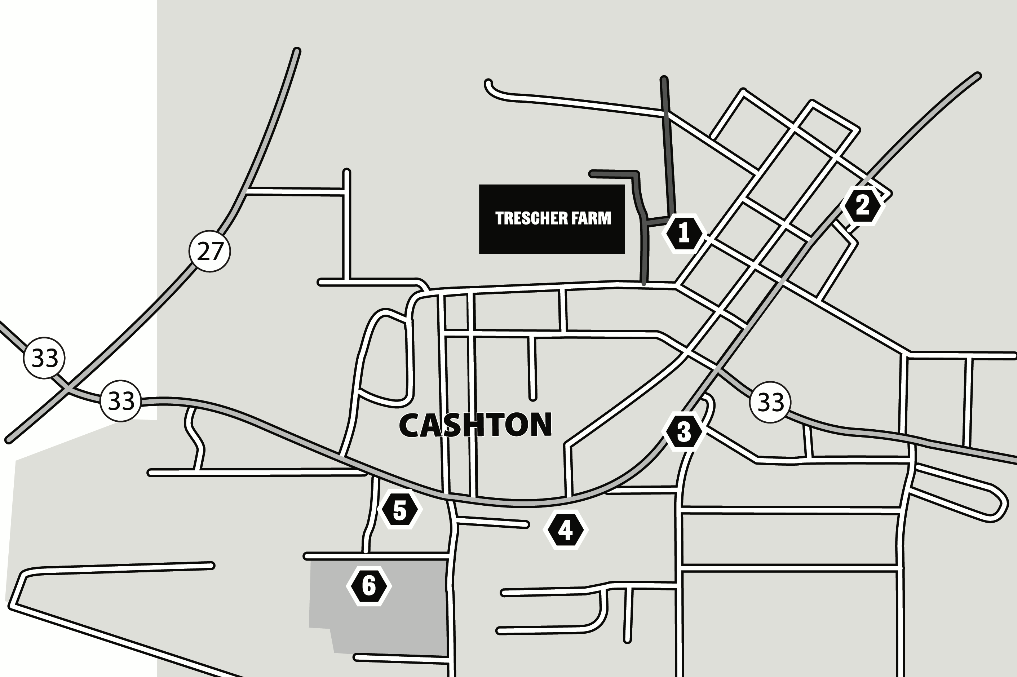
Map locations
Breakfast Location -Trescher Town-View Dairy
829 Cashton Ave. Cashton.
1205 Front St. Cashton.
540 Coe Street. Cashton.
436 Front Street. Cashton.
238 Front St. Cashton.
200 Park St. Cashton.


Comments
No comments on this item Please log in to comment by clicking here